
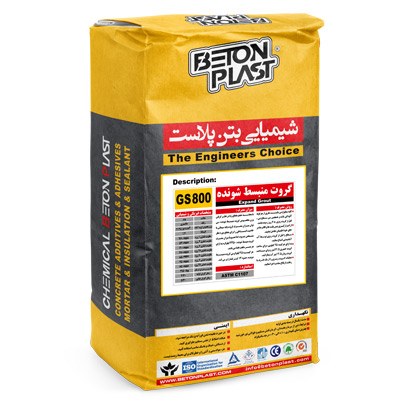
Expand grout
- It has high resistance against different weather conditions
- Increases adhesion between steel and concrete
- Has high resistance against high static forces
Description
Expand grout
In specific climatic conditions, water loss in the mortar, caused by high temperatures or improper curing, becomes more significant. In such situations, grout with higher free expansion is required to offset the shrinkage caused by water evaporation. Therefore, the use of Expand grout for grouting beneath base plates, particularly in environments with unique conditions, is an ideal choice.
After positioning and leveling the base plates and installing anchor bolts, the next step involves mounting and securing the base plates onto the foundation in steel structures. This stage is one of the primary concerns for contractors and clients. Since predicting the shrinkage or contraction of regular mortar, especially under varying weather conditions, is challenging and requires precision, the use of a specialized mortar with a unique formulation, known as cement grout, is recommended. Cement grout is designed to compensate for mortar shrinkage.
Expansive grout is composed of cement, aggregates with specific grading, polypropylene fibers, powdered plasticizers, and expansive additives. This type of grout exhibits high performance, suitable workability time, and remarkable early and final compressive strength. The resistance provided by expansive grout is significantly higher and more reliable compared to conventional cement mortars.
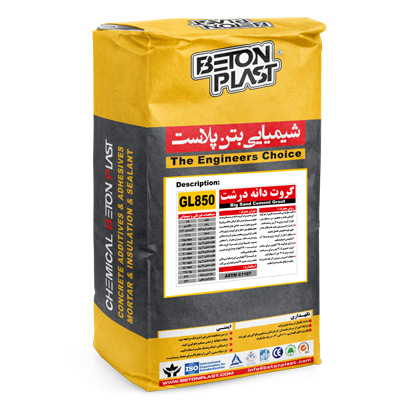
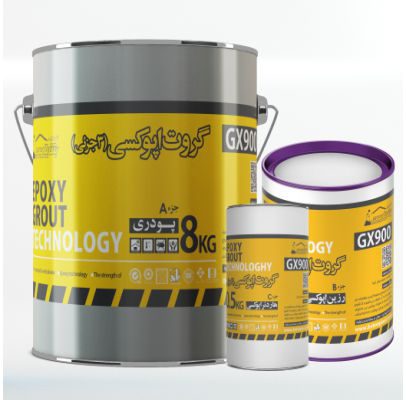
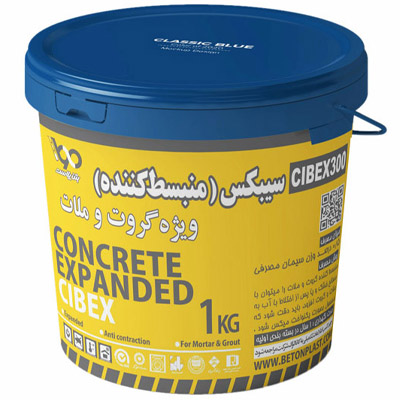
More products ; grout
When mixed with water, expansive grout demonstrates a two-phase volumetric expansion. The first phase is an initial expansion caused by the reaction of a solid material with gases, occurring upon mixing with water. The second phase involves expansion resulting from the chemical reactions of the setting process, which begins one to two days after mixing.

Features Expand grout
- Provides high fluidity and excellent workability.
- Offers lower permeability compared to traditional mortars.
- Prevents mortar shrinkage through controlled expansion.
- Demonstrates high resistance to various weather conditions.
- Protects steel from corrosion due to the absence of metallic aggregates and chlorides in its composition.
- Exhibits exceptional strength against heavy static loads.
- Prevents cracking and ensures no gaps form after hardening.
- Enables faster utilization of the structure.
- Delivers early high strength, allowing for quicker load application.
- Achieves optimal fluidity with minimal water usage.
- Prevents shrinkage caused by plastic settlement.
- Offers high workability without segregation or bleeding.
- Effectively enhances the bond between concrete and steel.
- Can be pumped easily, ensuring optimal flowability.
- Possesses excellent compressive strength.
- Resists impact and abrasion effectively.
- Creates strong and durable connections with adjacent structures.
- Does not require complex equipment for application.
- Maintains its properties under temperature variations.
- Offers high durability and long service life.
Applications
-
- Suitable for installing and securing base plates on foundations in steel structures.
- Used for mounting and stabilizing industrial machinery with high vibration and oscillation.
- Effective for grouting bridge foundations and filling voids between columns and bridges.
- Ideal for filling bolt holes left after formwork removal.
- Suitable for deep repairs and restoration projects.
- Applicable for grouting beneath base plates of transfer and movement rails in industrial facilities.
- Used effectively for installing and stabilizing power transmission towers.
- Suitable as a ready-to-use mortar for general and interior building applications.
- Ideal for stabilizing precast columns.
- Capable of injection into ducts of pre-tensioned cables.
- Suitable for filling holes, pits, and other void spaces.
- Practical for anchoring rebar and anchor bolts.
- Effective for filling gaps between steel and concrete, as well as reinforcing beams, columns, and steel jackets.
Procedure for Applying Expanding Grout
- Ensure the proper placement of base plates, and if needed, verify their levelness using a spirit level.
- The concrete surface for grout application must be at least 7 days old.
- Maintain a minimum gap of 10 mm between the underside of the base plates and the concrete surface.
- All surfaces in contact with the grout must be free of contamination, grease, dust, and any other impurities.
- If the concrete surface has weak or flaky areas, remove them using grinding, water jetting, or other physical methods until a solid, stable surface is achieved.
- The molds or formwork used for grout application must be non-permeable to prevent water leakage before the grout sets.
- The height of the molds for grouting should be 2 to 5 cm higher than the base plates.
- To prevent air bubbles during large-scale grouting, use a headbox. For smaller applications, use a slanted sheet with a 45-degree angle, 50 cm wide, and tailored to the mold’s length to ensure smooth, continuous flow.
- Before applying the grout, saturate the surface with clean water to prevent the dry surface from absorbing the grout water and causing cracks.
- Use a suitable container for mixing the grout powder with water. For a thick grout mixture, use 3.5 liters of water per 25 kg bag; for a flowable grout, use 4.5 liters.
- Gradually add the grout powder to the water while stirring with an electric mixer (drill with paddles) and continue mixing until a homogeneous mixture is obtained.
- Only prepare as much grout as can be used within 30 minutes after mixing.
- Do not add any additional materials, such as cement or aggregates, to the grout mixture.
- Begin pouring the grout from one side, allowing it to flow naturally to other areas. Use a metal rod or chain to aid flow if necessary.
- For larger sections, divide the area into smaller parts using temporary molds before proceeding with grouting.
- Ensure adequate space beneath the base plates to prevent air entrapment.
- Maintain an ambient temperature between 5°C and 30°C during the grouting process. High temperatures (>30°C) accelerate setting, while low temperatures (<5°C) delay it.
- In hot weather, store the grout in its original packaging in a shaded area, and use cold water for mixing. In cold weather, warm water is recommended.
- After grouting is complete and the initial set is achieved, cover the grout surface with a damp burlap layer and seal it with a plastic sheet to minimize water evaporation.
Perform surface curing for at least 7 days after grouting to ensure proper hydration and strength development.
Technical specification table
| state of | powder |
| Color | Gray |
| Special Weight | gr/cm3 2/35 |
| Standard | ASTM C 1107 |
| Chlorine ion | does not have |
| 1 day compressive strength | 300 kg/cm2 |
| 3-day compressive strength | 500 kg/cm2 |
| 7-day compressive strength | 550kg/cm2 |
| Compressive strength of 28 days | 590kg/cm2 |
| Time to start expansion | 20´ |
| Expansion termination time | 2 : 30´ |
Package
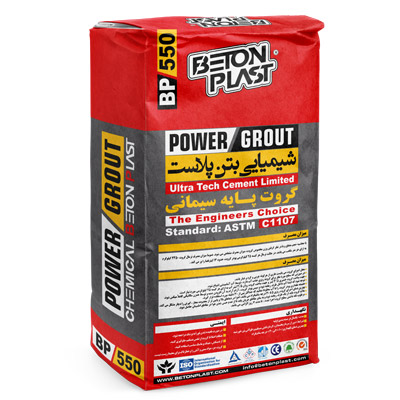
25kg bag
Reviews
There are no reviews yet.